R.I.P. PALACE AMUSEMENTS 1888 to MAY 26, 2004
This site is brought to you by Save Tillie, an all volunteer organization comprised of 1,000 friends of Asbury Park. Founded in July of 1998, our original goal of saving the Palace's iconic Tillie image expanded in 1999 to an attempt to save the entire Palace. Under our leadership, the Palace won an honored place on the New Jersey and National registers of Historic Places. Demolition of the Palace in 2004 came over the objections of the National Trust for Historic Preservation, the Asbury Park Historical Society, Preservation New Jersey, and Save Tillie. In the end, we saved more than 125 internal artifacts from the Palace and the Tillie mural from the Cookman Avenue wall, and through our work the Bumper Car murels on the Lake Avenue facade were also removed to storage.

Save Tillie
Beyond the Palace
FROM PHOENIXVILLE TO ASBURY PARK AND BACK
It's back!
And once again, by failing to act in its own best interest, one of Asbury Park’s signature attraction benefits another community.
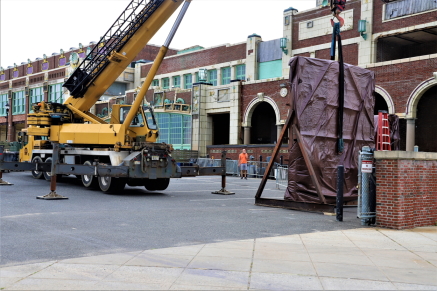
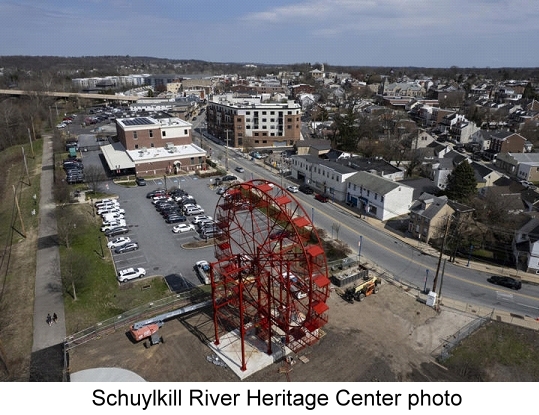
One hundred thirty-one years after Ernest S. Schnitzler commissioned Phoenix Iron and Bridge Company of Phoenixville, PA to build a Ferris wheel for Palace Amusements, the wheel is back where it began -- having travelled from Pennsylvania to New Jersey to Mississippi and back to New Jersey and now, reassembled and repainted, it rises bold and stark over downtown Phoenixville, where it was originally forged.
As told by Jerry Carino of the Asbury Park Press, a ribbon-cutting ceremony 10 a.m. June 6 culminates a $2.2 million restoration that includes 16 of the original 20 carriages, the motor, and all the connecting beams. The wheel doesn’t yet turn, but local advocates are working to get that done.
Carino’s excellent article, published June 3, 2026, traces the history of the wheel from the days when it carried riders from inside Palace Amusements to a rooftop observation deck to its final days in operation at the Palace in 1988, prior to being sold to a Mississippi amusement park, where it remained in use until 1997. (For more details , check out www.PalaceAmusements.com, the online Palace museum. Enter the museum online, find The Formative Years heading, and read the articles at 1895 and at The Wheel.)
Our friend Brian Mayer, who worked as an assistant manager at Palace Amusements, recalls that “the superstructure was red, but the cars were painted six blue, six yellow and six orange. The thing was so old (during its final Palace days) we were only allowed to load the blue ones, otherwise the darn thing wouldn’t do a revolution.” The entire wheel has now been repainted red in homage to its original color.
Don Stine, a past president of the Asbury Park Historical Society, told Carino he “very happy to see one of Asbury Park’s most famous amusement rides is getting a new life out where it was actually made.”
Mike Kajak, a member of the Schuylkill River Heritage Center board, said the restored wheel “stops everybody in their tracks when they see it. People are going to be traveling from near and far to see it, including people from Asbury Park who rode on it as kids.” Although the wheel is up, Kajak said fundraising will continue at www.phoenixvillefoundry.org/support-our-mission with an eye toward bringing it back into operation. We at Save Tillie have proudly purchased an inscribed brick that will be installed near the base of the wheel.
NJ Governor To Leave
Artifacts In The Hands
Of Hostile Officials
New Jersey’s outgoing Gov. Phil Murphy recently issued scores of pardons, commuted dozens of sentences, and named top allies to state boards and commissions as he prepares to leave office in January.
Now, his exit activities have taken a new turn. Rejecting the advice of preservationists in and out of government, the governor has refused to get involved in a crisis endangering thirty-one Asbury Park artifacts, leaving their future very much in doubt.
As first reported by the New Jersey Monitor, Murphy said through a spokesman that he is leaving the handling of the historic artifacts to the New Jersey Department of Environmental Protection. By doing so, responsibility for ensuring proper preservation and eventual reuse of the artifacts will remain with the same agency that for the past twenty-one years has ignored frequent warnings that the artifacts are degrading for lack of competent care.
As of today, the artifacts have been stored, out of public view, for over 7,850 days, with no end in sight.
The artifacts are all that remain from Palace Amusements, a 110-year-old waterfront arcade memorialized on the New Jersey and National Registers of Historic Places. Although required to do so by state officials, local developers who own the artifacts have failed to return any of the artifacts to public view; preservation treatment, which the state also required, has never been confirmed.
Since mid-September, preservation advocates in and out of state government have repeatedly urged Murphy to intervene in the crisis, hastening the creation of a public display connecting Asbury Park’s history in music and amusements to future generations of residents and tourists.
Senator Vin Gopal, Assemblywoman Margie Donlon, and Assemblywoman Luanne Peterpaul -- Asbury Park’s representatives in the state legislature -- warned Murphy that without his direct involvement, there is a threat that the artifacts “will be lost forever.” They urged Murphy to take “whatever action is necessary” to avoid that result, but to date, their appeal has produced no result.
Kelly Ruffel, executive director of Preservation New Jersey, a leading preservation organization, urged him to order an inspection of the artifacts by a qualified, professional conservator. The results of an independent inspection, coupled with a specific preservation plan, Ruffel said, would help prepare the artifacts for public display.
Save Tillie, an all-volunteer group of preservation advocates, told Murphy that preservation means “to provide competent management and technically appropriate techniques to protect the artifacts from decay, damage, and destruction.” Never once, they said, have local developers “provided evidence on ongoing preservation or treatment.”
Prominent New Jersey preservationist Robert Craig told Murphy that it is “shameful” that the preservation and reuse conditions remain unfulfilled. By resolving that situation, Craig said, Murphy would shore up public confidence in DEP by showing that when the department imposed binding conditions, “it will insist upon them, and enforce them."
Craig’s appeal referenced the binding conditions imposed by DEP in 2004 as a precursor to awarding waterfront redevelopment rights to local developers. Department officials required developers to preserve and reuse the artifacts after demolition of the Palace. The artifacts include three large wall murals, twenty-five metal channel letters, a wooden cutout depicting an amusements scene, and several small signs.
Developers Asbury Partners (2004-2009) and its successor organization Madison Marquette (2009 onward), agreed to the conditions, but ever since have kept the artifacts in storage, without confirming preservation measures other than storage. Over the same period, DEP officials have consistently rejected calls for it to enforce the binding conditions.
Responding to a media inquiry this week, DEP spokesman Vincent Grassi said the last time DEP staff viewed the artifacts was in 2018, finding them to be in “satisfactory condition.” That contention is at odds with the report by an independent, third-party inspector a year earlier, who found nearly all of the artifacts to be seriously degraded and in loss of artistic integrity.
Grassi told the Monitor that once a hotel or retail development is constructed at the former site of Palace Amusements, the preserved artifacts are required to be incorporated into the new building.” He failed to point out, however, that local developers are avoiding that requirement by using the property as a ground level parking lot.
Additional reading:
SAVE TILLIE UPDATE (September 2025)
By far, our most significant development so far this year was an offer from attorneys at a Hackensack, N.J. law firm to join the fight. These folks are experienced environmental lawyers; several are long-time Tillie fans. We were amazed to learn that one has a Tillie image in his home. We gratefully accepted their help, and the relationship has been solid from the beginning. Oh, and I should mention that they offered to represent us during this phase of the campaign without charge.
We've been impressed by their approach, which essentially involved reexamining the history of how the Palace artifacts went from being on the exterior walls of a National Register of Historic Places arcade to being stashed in storage for over 20 years. There's a lot of painful history which we have all lived through, all of which has now been revisited. And after doing so, the key facts today are these:
1. The crisis facing the artifacts goes back to the writing of the Asbury Park waterfront redevelopment permit in 2004. You'll probably recall that the permit was written by the New Jersey Department of Environmental Protection (NJDEP). In the section dealing with the Palace, state officials gave Asbury Park developers a sweetheart deal. Specifically, the developers who for years had been trying to get rid of the Palace were given the green light to demolish the Palace. And in the kind of sleight of hand NJDEP is famous for, the bureaucrats required developers to agree to remove, preserve, and reuse a group of Palace artifacts, BUT imposed no deadlines for when the artifacts were to be brought back to the public. Consequently, as we all know, for 20 years the artifacts have been stashed in sheds, and not one of the surviving 31 artifacts has been returned to the public.
2. Our review clearly demonstrates that the relationship between the developers and the City of Asbury Park is so toxic that the ability of city officials to deal meaningfully with the developers borders on zero. When we put that all together, it is very clear that there is no way this crisis will be resolved within Asbury Park.
Other steps have come into focus. This work is current, ongoing and is in capable hands. As soon as we have details and/or developments, we'll be in a position to share them.
Spotlight Shines On Historic Artifacts
Kept From View
By Asbury Park Developers
May 4, 2024
Since the demolition of Palace Amusements in Asbury Park 20 years ago, the one big unanswered question has been this: Would we ever see the surviving artifacts rescued from the walls of the historic amusements arcade?
There is a sliver of hope.
Preservation New Jersey, the state’s leading preservation organization, announced today that it has added Palace artifacts to its list of 10 Most Endangered Places for 2024.
Endangered? Absolutely. Back in 2004, the State of New Jersey signed a deal that led to the demolition of the Palace, four years after the arcade was listed on the National Register of Historic Places. The deal for far from perfect. But it contained an explicit promise. In exchange for lucrative waterfront development rights, developers pledged preservation and reuse of the artifacts.
Twenty years on, the artifacts have never been brought back.
Three large wall murals are in a wooden shed. Twenty-six decorative metal letters are said to be piled up in the notoriously neglected Convention Hall complex. A 75-year-old wooden door, drenched by Super Storm Sandy, is stashed in a beach front pavilion. Several artifacts have disappeared and have never been found.
When Paul Himmelstein, a former president of the American Institute for Conservation, conducted his third and final inspection of the artifacts in 2016, he documented serious rusting of the metal letters, and paint loss from the murals severe enough to threaten artistic integrity.
Why has this happened?
Because when crafting the deal, the New Jersey Department of Environmental Protection created a loophole. The rules were deliberately written without end dates. This has allowed developers to leave the artifacts in storage, where they face demolition by neglect.
At Save Tillie, we are deeply grateful to Preservation New Jersey for joining us in spotlighting the dangers. When historically significant artifacts are destroyed through neglect or demolition, they are gone forever. Every loss chips away at the unique character of a community.
It is imperative now that state officials undertake a long, hard, unbiased review of the deal, made in 2004, that has allowed the artifacts to be pushed to the brink of irretrievability.
The future of the artifacts remains uncertain, but with today’s announcement, a spotlight now shines on the endangered artifacts. Preservation New Jersey officials have promised technical assistance and support for the fight to preserve the artifacts.
Stay tuned.
TILLIE IS ON THE MOVE IN ASBURY PARK!
“Seventeen years ago, the state of New Jersey issued a requirement that historic artifacts from Palace Amusements be preserved, restored, and reused on the Asbury Park waterfront. None of the 33 preserved artifacts – including the Tillie and Bumper Car murals -- have been restored or reused. If the moving of the murals this week from locked storage sheds was done by Madison Marquette developers to facilitate restoration, we eagerly await details on who, when, where and how the restoration will be done. In the meanwhile, it is incumbent upon the developers to ensure that the sheds they started building Sept. 29 are secure and meet preservation standards for a waterfront environment."
Bob Crane, Save Tillie president
Read the NJ.Com story by Natalie Paterson on YouTube, Click HERE: Iconic N.J. mural moved out of storage
March 2021 Save Tillie Update:
FIRST PUBLIC VIEW OF TILLIE
AFTER 17 YEARS!!!
Yes, it has been 17 years since Tillie and 31 other Palace artifacts were placed in storage, out of public view. This, of course, was not the plan. When the State of New Jersey gave the green light to waterfront redevelopment in Asbury Park, it issued a binding requirement that the artifacts be preserved and then brought back to public view. Instead of doing so, the developers have left Tillie and the other artifacts in storage, and put in a parking lot where the artifacts were supposed to be used on a new building.
A dramatic video produced by a news crew at NJ.com amply demonstrates that storage, and preservation, are not the same. Storage can be done in a plywood box. Preservation requires a willingness to render treatments necessary to ensure visual and historic integrity and survival. The NJ.com video tells an entirely different story, of a joint venture that so far has invested more than $300 million on the waterfront but can't bring itself to preserve the very items that allow redevelopment to continue.
The video gives you a chance to view Tillie for the first time in 17 years, and judge for yourself if the current condition of the murals reflects the care of a preservation specialist. There is an invitation, at the end of the video, to post your comments.
Instagram: https://www.instagram.com/p/CL9oTNAHrCX/
IN THE HISTORY OF FOLK ART,
THERE'S NEVER BEEN AN ICON QUITE LIKE TILLIE.
Tillie – the one, the original – was last seen in public in 2004 upon removal from the exterior wall of Palace Amusements, the National Register of Historic Places complex at the corner of Cookman Avenue and Kingsley Street in Asbury Park. Removal was part of a deal between the State of New Jersey’s Department of Environmental Protection, the City of Asbury Park, and a property sales group to green-light redevelopment of the Asbury waterfront. The project was conditioned upon the preservation and reuse of Palace artifacts, including the Tillie mural.
Today, the Madison Marquette development group continues to keep Tillie locked up, out of public view, with no announced plans for its reuse as required by the 2004 agreement. In the view of many, Madison’s goal is allow the condition and visual integrity of Tillie and the other Palace artifacts to decline by neglect.
But wait, what’s this? Fifteen years down the road from removal, Tillie is a merchandising force in the shops of Asbury Park and Ocean Grove next door. Take a stroll through the Cookman Avenue business district, or go next door to Main Avenue in the picturesque Ocean Grove, and you’ll find Tillie images everywhere. On photographs, art prints, coffee cups,postcards, tee-shirts, buttons – literally, everywhere!
The latest, and to our eyes some of the nicest Tillie items grace the shelves at Main Avenue Galleria, 57 Main Avenue in Ocean Grove, where you’ll find the offerings by artist Ralph McGeehan. McGeehan presents realistic images of Tillie, including a classic photo of a representational Tillie aboard a carousel horse during Asbury Park’s 4th of July parade several years back.
If you drop in to any of the shops where Tillie lives on, give a word of thanks to the shop owners including Norma Tolliver at the Galleria for proving that famous icons are an integral part of the community’s future, as well as its past.
ANOTHER HISTORIC PALACE ADDITION
TO THE SILVERBALL MUSEUM
Unless you’re living under the proverbial rock, you know that pinball is the national pastime of Asbury Park. For decades, silver balls have ricocheted off plungers and bumpers along the Boardwalk, triggering the music of bells, chimes, and beepers that is as indigenous as the sound of the surf.
Opening in 2009, Silverball Museum fits perfectly into this tradition: a game room filled with classic machines from as early as 1950, all waiting to be played. Want to try Slick Chick by Gottlieb (1963)? Silverball Mania by Bally (1978)? Pirates of the Caribbean by Jersey Jack Pinball (2018)? They’re all there, and more.
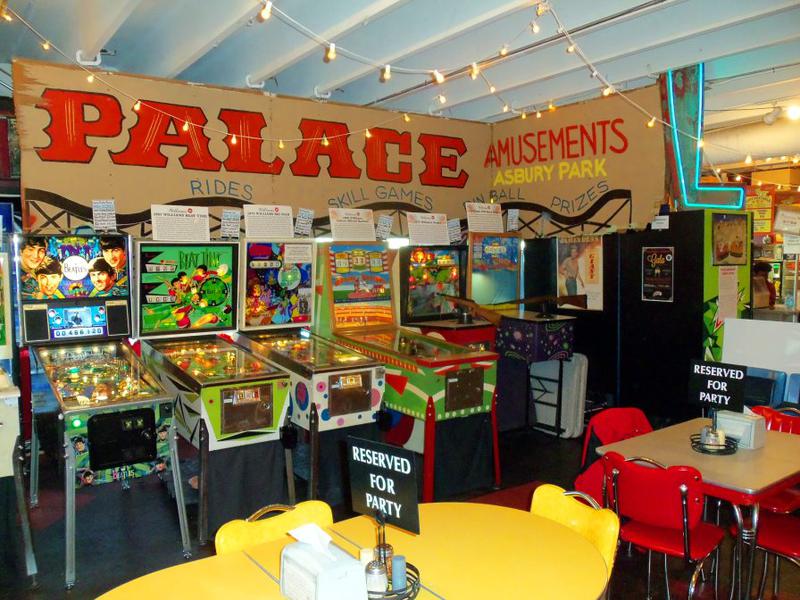
Recently, under the curatorial guidance of Silverball’s Dan Toskaner, the Museum has taken an extraordinary series of steps to strengthen its connection to Asbury Park history, acquiring and publicly displaying artifacts salvaged from Palace Amusements, a National Register of Historic Places complex destroyed by developers in 2004. The most recent high value addition is a large plywood sign that hung over the Palace business office inside the complex. On loan from the Asbury Park Historical Society, the sign is an astonishing survivor of the pillage that resulted in the destruction of hundreds of valuable artifacts left behind following the closing of the Palace.
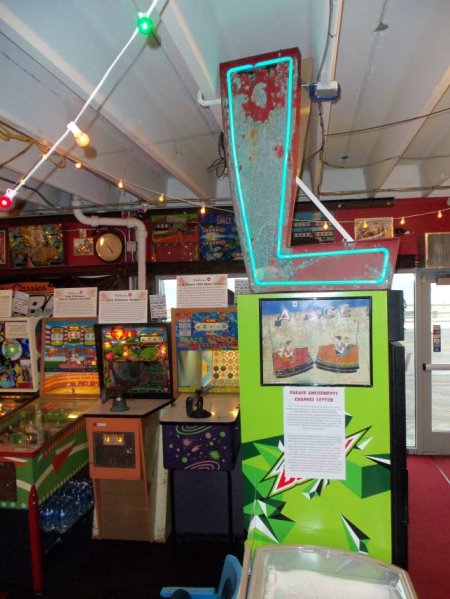
The sign is the third Palace artifact to find a home at Silverball, joining a classic photo booth and a metal channel letter “L” with restored neon, originally part of the P A L A C E rooftop sign facing Wesley Lake. Announcing his latest addition, Toskaner said with a smile that it was hung “as part of my continuing effort to collect enough artifacts to put the Palace back together again.” The way he said it suggests that Toskaner has additional plans. We can hardly wait to see what’s next!
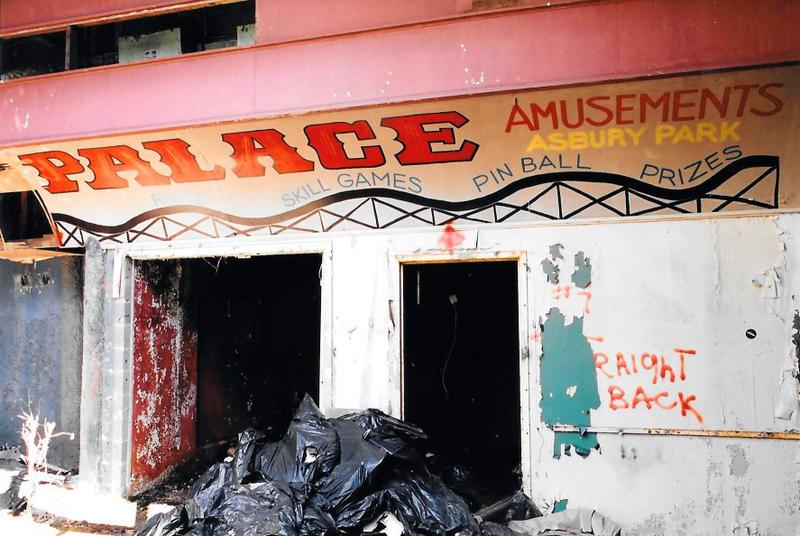
THEN AND NOW: In its original location, the interior Palace Amusements sign hung over the entry to the business office where, somehow, it miraculously survived the rampant vandalism that destroyed hundreds of historic artifacts in the famed National Register of Historic Places complex. In its new location, the sign hangs from the ceiling at Silverball Museum along the Boardwalk.
AN EXCELLENT HOLIDAY GIFT
FROM THE SILVERBALL MUSEUM
Big kudos to the guys at The Silverball Museum, that palace of pleasure machines on the Asbury Park Boardwalk!
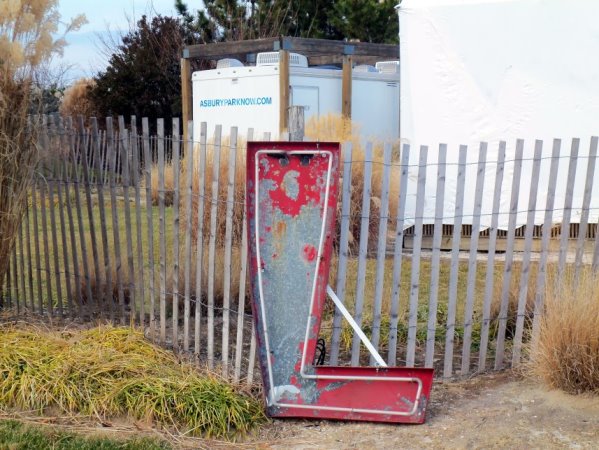
Newly hung from the ceiling, neon shining brightly, is a historic metal channel letter “L” that was once part of the P A L A C E rooftop display above the Skooter Murals on the Wesley Lake side of Palace Amusements.
As told by Silverball’s Senior Technician Dan Toskaner, the “L” belonged to Asbury businessman James Kaufman, who hung it in a prominent position in his Flying Saucers store on Cookman Avenue. With Flying Saucers relocating to the Antique Emporium next door, he offered the “L” to Silverball, which also has a Palace Amusements photo booth on display.
“We’re thrilled to have it,” Toskaner told Save Tillie. “To us, the “L” stands for “Lives on,” reflecting the attitude of so many about the memory of Palace Amusements.
Next time you’re on the Boardwalk, stop by and see it for yourself. It is spectacular in the new location, and makes one wonder why, after all these years, the owners of all the other Palace artifacts – Madison Marquette – is keeping the iconic murals and metal channel letters in storage and out of public display.
Oh, and by the way, while being transported from Flying Saucers to Silverball, the “L” made a sentimental ground level stop under its original location along Lake Avenue.
NEW PALACE AMUSEMENTS REPORT:
HISTORIC ARTIFACTS DETERIORATE SIGNIFICANTLY
ASBURY PARK -- Twenty-nine historic artifacts protected under an agreement between the City of Asbury Park, its waterfront developers and a state agency have deteriorated over the past two years to the point of losing visual and structural integrity, according to a conservator who recently inspected the artifacts.
The inspection identified three wall murals that have lost “significant” paint and are “beginning to lose their detail,” and 26 metal letters that are rusting and in danger.
“A decision about the final disposition of these important historic objects should be put in place as soon as possible,” said Paul Himmelstein, a New York conservator, who inspected the artifacts in their storage locations along Asbury Park's waterfront. Otherwise, he said, the historic authenticity of the artifacts is in peril.
The threats discovered during the inspection brings into sharp focus several major dangers facing the removed artifacts, said Bob Crane, president of the non-profit group Save Tillie, which as part of its advocacy for preservation of the artifacts paid for the Himmelstein inspection.
“This report very clearly demonstrates why storage by itself is not preservation,” Crane said. “Preservation of historic resources requires frequent evaluation and the application of preservation treatments.” Except for Himmelstein’s privately funded inspections of the storage sites in 2005, 2014 and 2016, there is no evidence, Crane said, of professional evaluation, and none of preservation treatment by the owners. “Instead of preservation, we have deterioration that is, essentially, demolition by neglect.”
Furthermore, the original agreement to reuse the Palace artifacts in a new building rings hollow, Crane said, as there are no plans to construct a new building on the Palace site adjacent to Wesley Lake. Instead, there are economic incentives against new construction, since most of the site was transformed years ago into a lucrative street-level parking lot.
Likewise, planners at the Madison Marquette waterfront development firm appear disinclined to relocate the artifacts to any site which is currently on the market for fear of tying the hands of potential buyers. “The City and the developers have financial conflicts of interest which have led them to avoid the 2004 agreement in favor of parking revenue and marketing priorities,” Crane said. “As a result, the artifacts have been left to decay.”
This is not the situation the New Jersey Department of Environmental Protection specified when it issued the redevelopment permit in 2004, Crane pointed out. “By insisting on the preservation of Palace features, the state recognized that these artifacts are physical records of the events and people that shaped local history, and therefore provide meaning to life today and into the future. Historic artifacts provide economic and cultural value, which will be lost if these artifacts are significantly altered or destroyed.”
In 2004, he added, the state government offered Asbury Park a deal. Despite being listing on the National Register of Historic Places, the City and its developers could demolish Palace Amusements in exchange for a pledge to preserve and reuse the artifacts. “Well, the Palace was demolished and can’t be put back together,” Crane said. “It is now time for the City and its developers to honor the pledge.”
In 2012, three of the protected Palace features were reported lost, prompting the New Jersey Department of Environmental Protect to issue a warning letter containing new reporting requirement to the City and Madison Marquette. Future violations, said state officials, were punishable by fines of up to $25,000-a-day.
2016 HIMMELSTEIN REPORT
Asbury Park, N.J.
Murals – “Tillie” and “Bumper Cars”
Metal Channel Letters, National Register of Historic Places Sign, Wooden Cutouts (overhead door)
Report on Site Visit and Recommendations for Continued Protection
I had inspected the murals in 2005 to review their condition and made recommendations for changes to the structures in which they were stored (see my report of September 2005). I inspected the murals again in 2014, as well as the metal channel letters, the National Register of Historic Places sign, and the wooden cutouts. I made several recommendations in my report of that inspection. These included painting the exterior of the sheds in which the murals are stored as a security measure, the use of traffic barriers to protect the sheds, and the relocation of the wooden cutouts from its sea level storage in the Casino building. (See my report of July 2014.)
On November 18, 2016 I carried out another site visit. I examined the murals, still housed in the sheds located at the City’s Sewage Treatment Plant; the metal channel letters and the National Register of Historic Places sign in the 4th Avenue Pavilion; and the wooden cutouts, now relocated to the Sunset Pavilion.
Over the past two years, the murals have lost some significant additional paint from their surfaces. Quite a number of new paint chips were observed on the top surfaces of debris located on the floors of the sheds. Some areas of the designs are beginning to lose their details as a result of this paint loss. Additionally, one of the bumper car murals has a horizontal crack. No mold was observed on the surfaces of the murals.
The recommendation to paint the exteriors of the sheds has not been carried out, and the outsides of the two sheds look even more “abandoned” than they did previously. No physical barriers on the outside of the sheds have been erected to prevent damage to the sheds from vehicles, as I previously recommended.
The metal channel letters had been removed for my examination from a locked room on the second floor of the 4th Avenue Pavilion, which is where I examined them in 2014. The letters show additional rusting on their surfaces. If this continues they will lose their structural integrity.
The wood overhead door, with cutouts, previously damaged in Superstorm Sandy, has been moved to a new location in the Sunset Pavilion. The cutouts were covered with a variety of plastic tarps. Since the pieces are quite large, they were not removed from their location for a complete overall examination. Examination in situ showed that the wood has dried without warping, and the cutouts appear to be stable.
RECOMMENDATIONS
As discussed in my previous report, the continued loss of paint from the surfaces of the murals will eventually lead to the loss of an authentic surface, and even to the possibility of accurately repainting them. They are now in danger of reaching that point fairly soon. A procedure to arrive at a decision about the final disposition of these important historic objects should be put in place as soon as possible.
Debris on the floors of the sheds should be removed so that paint loss from the murals can be monitored. To prevent further infiltration of outside debris through the air vents, they should be lined with metal window screening.
A more appropriate covering material should be used on the overhead doors. Tyvek or a similar material should be used.
To reduce the rate of rusting on the channel letters the room in which they are stored should be equipped with a dehumidifier attached to a drain. To make this as efficient as possible, the room should be lined with 6ml polyethylene, with the appropriate tape used to secure the edges. This will reduce the load on the humidifier. However, my recommendation regarding the murals applies here as well: a decision about the final disposition of these important historic objects should be put in place as soon as possible.
Paul Himmelstein
2 December 2016
2014 HIMMELSTEIN REPORT
Asbury Park, N.J.
Murals – “Tillie” and “Bumper Cars”
Metal Channel Letters, National Register of Historic Places Sign, Wooden Cutouts (overhead door)
Report on Site Visit and Recommendations for Continued Protection
I had inspected the murals in 2005 to review their condition and made recommendations for changes to the structures in which they were stored (see my report of September 2005).
On June 19, 2014 I inspected the above items to review their condition and their current storage spaces.
Most of my 2005 recommendations for changes in the structures used to store the wall murals appear to have been carried out. One of the suggestions, for physical barriers placed to protect the outside of the enclosures from damage by vehicles has, however, not been carried out.
In addition, the outside of the plywood is somewhat deteriorated, and the sheds look “abandoned.” My initial recommendation to paint the outsides and maintain a “cared-for” appearance is still an important issue. Vandalism is less likely to occur if the sheds look like someone is taking care of them.
Since my inspection in 2005, the murals have remained in the storage sheds outside the City’s Sewage Treatment Plant. There was some evidence of water staining in strips at the bottoms of the murals, probably as a result of water intrusion during Sandy. The water does not appear to have done any substantial damage to the blocks or paint. There is no evidence of mold growth on the surface of the murals.
The high density cinder blocks on which the murals are painted and the mortar between the blocks appear to be in fairly stable condition. There is minor evidence of cracking and structural deterioration; these conditions should be frequently inspected. However, it appears that there are some new paint losses. Although the recent losses are small, the process of deterioration is continuing. The more losses that occur, the more difficult it will become to reconstruct the original design. Regular examination is essential to determine when the continuing loss of paint (and resulting loss of significant details) would jeopardize the ability to repaint the murals in accordance with their original appearance.
The metal channel letters and the National Register of Historic Places sign are stored in a locked room on the second floor of the 4th Avenue Pavilion. The overhead light fixture in the storage room was inoperative, so I did not attempt to count or examine all the metal channel letters (of which there are supposed to be 26.) While there is evidence of some rusting, in general the letters appear to be stable. Along with the letters, the room contains some original lighting fixtures and other historic artifacts from properties other than Palace Amusements. An inventory of all of the items in the room should be created, and signed by all parties involved. This would help to confirm that all items that are now stored there remain in the room.
The wooden cutouts on the overhead door are stored in a ground-floor area of the Casino Arcade Building. The lower portion of the cutout I examined appears to have been soaked during Sandy, and the wood at the bottom shows considerable deterioration. Further deterioration would likely lead to substantial instability of the entire assembly. Because damp wood is a magnet for insects, the cutouts should be moved to a dry location, and should be raised off the floor for storage. A complete restoration of these cutouts in the future would be possible only if the appropriate steps are taken now to slow the continuing deterioration.
Finally, a regular inspection schedule (at least once a year) of the objects in storage, by a conservator, should be established. This will help to assure that minor condition problems do not turn into major ones.
Paul Himmelstein
9 July 2014
2005 HIMMELSTEIN REPORT
Asbury Park, N.J.
Murals - "Tillie" and "Bumper Cars"
Report on Site Visit and Recommendations for Continued Protection
On August 18, 2005 I inspected three murals removed from the Palace Amusements complex in Asbury Park, NJ and now stored in enclosures in the parking lot of the Asbury Park sewage treatment plant at 8th and Ocean Avenues.
The murals were executed on outside walls of the complex. The walls were constructed from high-density cinder blocks and their appears to be a coating, perhaps stucco, over the cinder block surface. The paint appears to be an oil-type.
To facilitate removal from their original locations, the murals and the cinder block walls on which they were executed were cut out and surrounded with steel frames. The frames were reinforced with welded steel cross braces that are about an inch from the surfaces of the murals.
The murals are now stored in two sheds constructed from 2x4s and plywood. The plywood was nailed to the 2x4s and caulking was been applied to the outside of the plywood joints. The plywood was reportedly “recycled” from another site and is not in very good condition. It was unclear from visual inspection whether the plywood is “marine grade” (i.e. manufactured using non-water-soluble adhesives) and therefore suitable for exterior use, or not. Peaked roofs were added to the sheds sometime after their original construction. These additions sit on the sheds, but the interiors of the two portions do not communicate with each other. The sheds sit directly on the asphalt of the parking lot; there is no “floor” to either of the sheds.
One section of plywood had been removed from each shed to permit my inspection. The sections were located at the bottom of each shed on the painted side of the murals. (The two portions of the “Bumper car” mural are stored back to back in a single shed so two sections were removed on this shed.) Judging by comparison with detail photographs, the condition of the murals appears not to have changed in any substantial way from that immediately after their removal. The paint is quite brittle and is curled away from the surface in many areas, and there are scattered losses throughout. There were only very small pieces of paint on the ground inside the sheds, indicating that no substantial losses had occurred since the murals were enclosed.
The murals and their supporting walls should not be substantially affected by changes in relative humidity (RH) and temperature, although changes in RH might cause some efflorescence of any soluble salts that may have entered the mural structures due to their proximity to the ocean. The two agents of deterioration most likely to cause damage to these works of art during storage are mold and staining from rusting of the steel frame and braces. In addition, physical damage from blows to the outside of the sheds could cause substantial damage.
Mold is most likely to grow when three conditions exist: still air, darkness and high relative humidity. Rusting has already occurred on the surface of the steel, but no rust has reached the surfaces of the murals. A truck backing up in the lot could also cause a catastrophic loss of one of the sheds and its enclosed mural.
To alleviate the problems outlined above, the following recommendations were discussed during the site visit, and should be implemented:
• Physical barriers, perhaps concrete highway barriers, should be installed on the lot sides of the two sheds.
Physical barriers, perhaps concrete highway barriers, should be installed on the lot sides of the two sheds.•Ventilation grills should be installed at the bottom and top of each shed to allow air to circulate within the sheds. These grills should be sturdy enough to prevent birds and curious people from gaining access. The grills should be backed up with standard home furnace filters to prevent larger particulate matter from entering the sheds. Two sets of grills should be installed on each shed, on opposing walls. Care should be taken so that wind-driven rain will not be able to enter through these grills.
Ventilation grills should be installed at the bottom and top of each shed to allow air to circulate within the sheds. These grills should be sturdy enough to prevent birds and curious people from gaining access. The grills should be backed up with standard home furnace filters to prevent larger particulate matter from entering the sheds. Two sets of grills should be installed on each shed, on opposing walls. Care should be taken so that wind-driven rain will not be able to enter through these grills.•The roof structure of each shed should be rebuilt so that the roof overhangs the shed on all sides, and appropriate flashing should be installed. It is essential that no liquid water penetrate into the interior of the sheds. Any liquid water that lands on the steel is likely to run off and cause staining of the painted surfaces of the murals. Such staining would be almost impossible to remove.
The roof structure of each shed should be rebuilt so that the roof overhangs the shed on all sides, and appropriate flashing should be installed. It is essential that no liquid water penetrate into the interior of the sheds. Any liquid water that lands on the steel is likely to run off and cause staining of the painted surfaces of the murals. Such staining would be almost impossible to remove.•As agreed on site during the inspection, the walls of the sheds should be rebuilt, using screws (rather than nails) and appropriate gaskets so that the structures are waterproof and long lasting. In addition, hinged doors with appropriate locks should be installed to permit easy regular inspection of the mural surfaces.
As agreed on site during the inspection, the walls of the sheds should be rebuilt, using screws (rather than nails) and appropriate gaskets so that the structures are waterproof and long lasting. In addition, hinged doors with appropriate locks should be installed to permit easy regular inspection of the mural surfaces.•The condition of the plywood should be monitored. Any panels that deteriorate to such an extent that they compromise the safety of the murals should be replace at once, using plywood rated for outdoor use.
The condition of the plywood should be monitored. Any panels that deteriorate to such an extent that they compromise the safety of the murals should be replace at once, using plywood rated for outdoor use.•It would improve the security of the sheds if they were painted to look more like permanent components of the treatment plant. At present their makeshift appearance invites vandalism and careless handling.
It would improve the security of the sheds if they were painted to look more like permanent components of the treatment plant. At present their makeshift appearance invites vandalism and careless handling.With the above changes and safeguards in place, I believe these murals can be stored safely in their present location. Regular quarterly inspections would help to insure that the murals continue to be in stable condition and protected appropriately.
Paul Himmelstein
September 2005
The Tillie and Bumper Girls murals, and other Palace artifacts were inspected on three occasions. The inspections were conducted by Paul Himmelstein, an independent, professional conservator who specializes in preventative conservation and were paid for by the nonprofit group Save Tillie.
Click to go to: